
A voice bounced down our dormitory hallway: “Phone for Jessie!”
On the pay phone in the stairwell, it was my Mom. “Jessie, I’m sending you and your brother plane tickets. Reverend King is preaching on Sunday; he’s coming to the house for lunch. You kids come on home.”
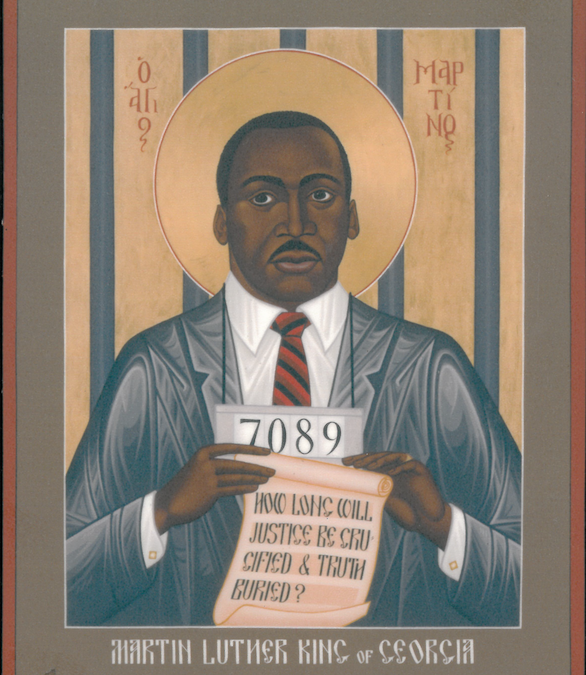
It was March, 1968. I was a sophomore at Oberlin College in Ohio, still a teenager. My father was Dean of Washington Cathedral, the big gothic “National Church” still under construction on the highest hill in Washington. Our house was across the drive from the cathedral. The Rev. Dr. Martin Luther King was to be the guest preacher that Sunday. So, as usual, the guest preacher was coming to our house for lunch afterward.
It would be anything but a usual Sunday lunch seated around our dining room table. Mrs. King was not traveling with her husband that week; we would not be able to welcome her into our home. We would not even eat together at the table. There would be too many people coming and going. My mother arranged for help in the kitchen: I’ll never know how many hot Sunday lunches she served buffet-style that day from our dining room. There was something else different too: as all four of us kidstrooped over to church behind my mother for the 11:00 service, I noticed two of the Cathedral Guards had already taken places by our front door. Never before had my father asked for a security detail in our own front yard.
Before lunch, of course, came the service. Wearing his Doctoral robes, Rev. King processed down the long cathedral center aisle, walking in the place of honor amid all the cathedral clergy, acolytes, vergers, and choir. All around them, the organ and congregation surged through the opening hymn. Our seats were always in the choir section. That meant we would see nothing but Dr. King’s back during the entire service. We couldn’t see him at all as he climbed up into the Canterbury Pulpit and delivered his sermon. But we could hear his rich, powerfulvoice just fine. He took John Donne’s famous poem as one ofhis texts that morning: “Send not to know for whom the bell tolls. It tolls for you.” I wonder how many folks in the congregation that morning failed, as I did, to fully let myself hear that Dr. King was speaking about and directly to me.
After the service we all rushed home and took up our stations. Older kids plus a cousin passed the trays of liquid refreshment, younger children offered baskets of pre-lunch bites. Many of our visitors were not staying for lunch, but were there to greet Dr. King when he arrived at the house. Finally, they came in the door: my father and Dr. King. For me it was as though a celestial body had entered the house. Dr. King was simply larger than life. He projected a true aura, a calm, confident, steady, and absolutely unyielding majesty. I have never been in a presence like Dr. King’s. And he was tired. I didn’t see it in any creases on his face or in his regal way of moving through the crowded rooms. I didn’t hear it anywhere in the sermon he had just finished preaching. I saw it when my mother seated him on our blue couch. She put him in the middle of the couch. He leaned back and settled in and let down a little, remaining present and available, but clearly glad for the nourishing comfortof a chance to sit down and rest on some comfortable cushions. It seemed as though the hubub all around him understood: I don’t remember that anyone chose to sit down next to him, and a situation never developed where he ended up speaking to the whole room. After the main course I brought Dr. King a plate of vanilla ice cream, and I sat his feet for a couple of minutes. He looked down at me for a moment, acknowledged me with a tinynod. While I was there, someone asked him his favorite hymn. “Amazing Grace,” he answered.
I don’t remember the moments when Dr. King left our house, only the moments afterward when I stood next to my father in the yard, still saying good bye to our many guests. A breeze had come up. It seemed as though the wind was whistling through an empty place. Dr. King was gone.
Four days later I was back at Oberlin, walking over to dinner with a friend. Another friend came running up to us. She was weeping. “They killed Martin Luther King,” she told us.
– Written by Mrs. Jessie Maeck, St. Ambrose Vestry Member.
Oh, Jessie, what a beautiful story amd so well told. I remember Thomas talking about that Sunday but not about the lunch or from this perspective. Thank you. Sara
Jessie, Thank you for sharing that story. How wonderful you had a chance to meet that remarkable man in person.