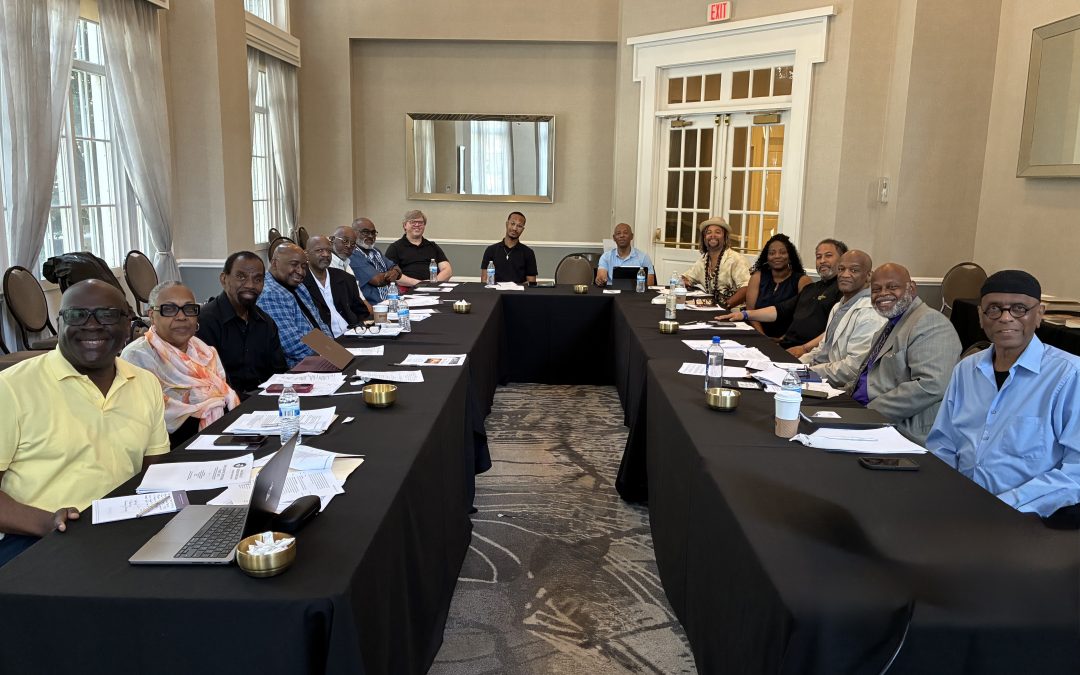
Norwalk, Connecticut — The Association of Anglican Musicians hosted the inaugural Justice, Mercy, & Music
Symposium on June 12th in Atlanta, Georgia. Focusing on the sustainability of historically Black parishes and the
promotion of Afro-Centric Liturgy and Music within the Episcopal Church, the Symposium addressed two main
questions: a) How does our history in Episcopal African Diasporic congregations inform our present and future use of
music, and b) What does justice and mercy look like in the Episcopal Church?
Among the invited scholars who participated in the Symposium, many of the oldest historically Black parishes were
represented:
African Episcopal Church of St. Thomas, Philadelphia, PA, 1972 (Waltier Blocker)
St. Philip’s Episcopal Church, Harlem, New York City, NY, 1809 (Charles Lovell)
St. Paul’s Episcopal Church, Paterson, NJ, 1817 (Gail Blache-Gill)
Christ Church, Riverdale, Bronx, NY, 1864 (Malik Jardine)
St. Ambrose Episcopal Church, Raleigh, NC, 1868 (Christian Foushee-Green)
Grace Episcopal Church, Norfolk, VA, 1883 (Terry Butler)
Cathedral Church of St. Peter and St. Paul (National Cathedral), Washington, DC, 1893/1907 (Michele Fowlin)
Episcopal Church of the Transfiguration, Miami Gardens, FL, 1957 (Lloyd Brockington)
Symposium participants heard presentations and assisted in workshops prepared by AAM members Dr. Carl MaultsBy,
Dr. Carl Haywood, Gregory Deane Smith, and R. Steven LeGall. Sessions included:
Historical context and evolution of Afro-centric music in the Episcopal Church,
Using music to promulgate justice and mercy in the life of the Church,
● Afro-centric liturgical planning for major feast days,
● Crafting new Afro-centric liturgies, and
● an Afro-centric choral reading session
Following the Symposium, Waltier Blocker wrote, “this symposium reminds us that we belong in these spaces and that
our voices matter. Everybody comes with their own story, their own gifts, and their own way of serving God’s people.
When we get the chance to listen, share, and learn from one another, we all leave stronger. Justice, mercy, and music
belong together because the church’s song should speak to what people are really going through. It should honor those
who came before us, make room for those who have been overlooked, and give hope to those who need it most.”
Although seed funding came from the Endowment Fund of the Association of Anglican Musicians, the Symposium would
not have been possible without generous support from the Episcopal Diocese of Southern Virginia, the Episcopal Diocese
of Central Florida, Judith Moore, Saint Thomas Church Fifth Avenue, The Episcopal Diocese of Pennsylvania, Trinity
Church New York City, and William P. Saviers.
Recent Comments